Editor at sweeptastic
Published on 01 Jul 2026
5 min read
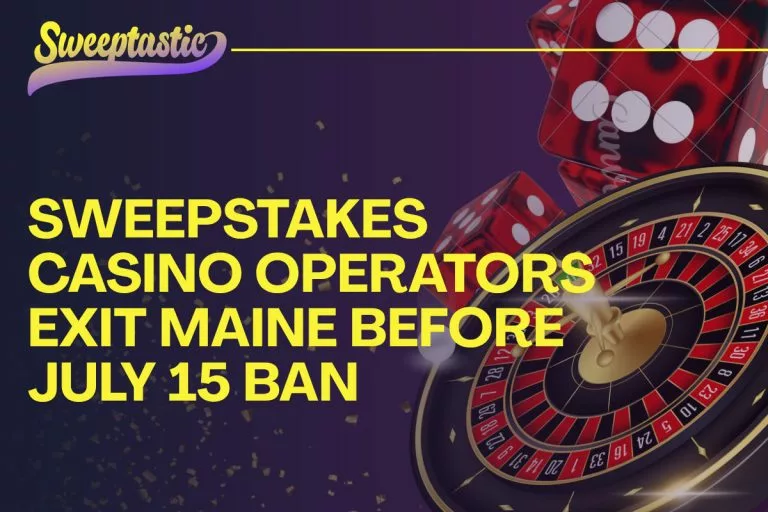
As a deadline to exit the Maine sweepstakes casino market approaches, ten notable site operators have announced their exit. Those announcements are due to a new law that goes into effect on July 15, which would make it a crime to operate an online sweepstakes casino in Maine.
In recent weeks, top operators like Spree, Baba Casino, and Pulsz have exited Maine. Meanwhile, Modo, Blazesoft, Funzpoints, Ace, Ruby Sweeps, and Peak Play also announced they are leaving the Maine market.
B-Two announced it would leave, though it plans to continue operations until the law goes into effect on July 15.

Retiring Maine Governor Janet Mills signed a sweepstakes casino ban on April 6. The new law classifies dual-currency, casino-style online sweepstakes games as unlawful gambling in the Pine Tree State.
The statute established several civil penalties related to unlawful conduct. Violators of the law can face fines between $10,000 and $100,000.
Also, anyone operating or promoting online sweepstakes sites that have a license with the Gambling Control Board or the Gambling Control Unit will have their license revoked.
Maine Legislative Document (LD) 2007 is alternately titled “An Act Regarding the Prohibition of Online Sweepstakes Casinos.” The statute specifically bans combining casino-style games with the purchase of tokens or coins that can later be converted into cash.
Games listed in the statute include online slots, table games, and bingo. Any fines collected will be sent to the Maine Gambling Addiction Prevention and Treatment Fund.
Online sweepstakes casino operators have now left the Maine market, but more established rivals appear poised to soon challenge the land-based casinos.
Legislative Document 1164, which was championed by Aaron Dana, gives the state’s four Wabanaki Nations the sole right to secure online casino licenses. Under provisions of LD 1164, each tribe can contract with a commercial operator to offer online slots, table games, and poker to Maine residents.
Caesars has moved to enter into commercial agreements with the Penobscot Nation, the Mi’kmaq Nation, the Passamaquoddy Tribe, and the Houlton Band of Maliseet Indians. The Oxford Casino filed a lawsuit to have the new law nullified, as it bars the state’s two commercial land-based casinos from offering online casino games.
The new legislation is part of a general push to expand sports betting and online gambling in Maine.
On June 16, the Gambling Control Unit held a meeting at the Hollywood Casino in Bangor, Maine. The GCU announced after the meeting that Caesars Entertainment would enter the online casino market as part of its deal with the Wabanaki Nations.
Rush Street Gaming has expressed interest in entering the market when it launches in 2027. Meanwhile, a new bill making its way through the Maine Senate would bar online sports bettors from using credit cards to make deposits at sportsbooks online.
For years, two gaming companies have dominated most gaming in Maine. Gaming and Leisure Properties (GLPI), a corporate spin-off of Penn National Gaming, owns the Hollywood Casino in Bangor. GLPI leases the facility to Penn Nation, which manages the property.
Since 2013, Churchill Downs Incorporated, the parent company of Churchill Downs (home of the Kentucky Derby), has owned the Oxford Casino in Oxford, Maine.
The Gambling Control Board regulates and licenses iGaming in the state, as well as land-based slot machines and table games. The Maine Gambling Control Unit conducts inspections and day-to-day enforcement.
The Director of the MGCU oversees advance deposit wagering, sports betting, and fantasy contests.